Contributing to Automator
Thank you for your interest in contributing to Automator.
This project supports research automation involving physical hardware. As such, contributions are welcomed, but must follow clear rules to preserve correctness, safety, and documentation integrity.
Contribution scope
Contributions may include:
- Bug fixes
- Documentation improvements
- Refactoring with no behavioral change
- Performance or reliability improvements
- Additional tests or validation tooling
Contributions that affect hardware behavior, safety logic, or system operation require additional review (see below).
Documentation governance (important)
The following documents are considered release-controlled:
README.mdRunBook.mdHandOver.mdHowToUseAutomator.mdChangeLog.mdHARDWARE_BUTTONS_AND_SERVICES.mdOS_and_Firmware_installation.mdSecurity_Model_Credential_Management.mddiagnosticsserver.mdnetworkandprintsettings.mdmodel_provenance.md- Any safety, security, or operational documentation
Rules for these documents
Changes to release-controlled documents must correspond to at least one of:
- a verified behavior change
- a safety or risk-model change
- a change in intended use or scope
Cosmetic edits (formatting, wording) are acceptable.
Meaningful changes must be justified in the pull request description.
Release and version baseline
- Current released baseline is
v3.0.0. - If behavior, operations, or security posture changes, update
ChangeLog.mdin the same pull request. - Use
ChangeLog.mdsection structure (Added,Changed,Fixed,Removed) for release notes.
Runtime boundary rules
Automator has separate runtimes:
- Controller runtime:
dev2/maincontroller.py+ imaging UI templates - Diagnostics runtime:
dev2/maindiagnostics.py+dev2/main_mjpeg_server.py+ diagnostics templates
Contributors must:
- State clearly which runtime is affected.
- Avoid mixing unrelated controller and diagnostics changes in one pull request.
- Update corresponding docs when runtime behavior changes.
Safety-Critical changes
Any change that affects:
- physical motion
- emergency stop behavior
- pause / resume logic
- GPIO usage
- hardware timing
- power or actuator control
must:
- Clearly describe the change and its motivation
- State any new risks introduced
- Confirm that existing safety guarantees still hold
- Avoid overstating safety or certification claims
Software emergency stops are considered best-effort controls and must never be described as safety-rated systems.
Hardware assumptions
- Do not assume GPIO availability without documentation
- Do not share GPIO pins between processes
- Avoid historically reserved GPIOs unless justified
- A separate, hard-wired, latching external emergency stop is required; it is wired on the AC input and cuts power to all system supplies in an emergency. This hardware emergency stop is separate from the software/UI emergency stop control (reference:
hardware/images/estop.jpg).
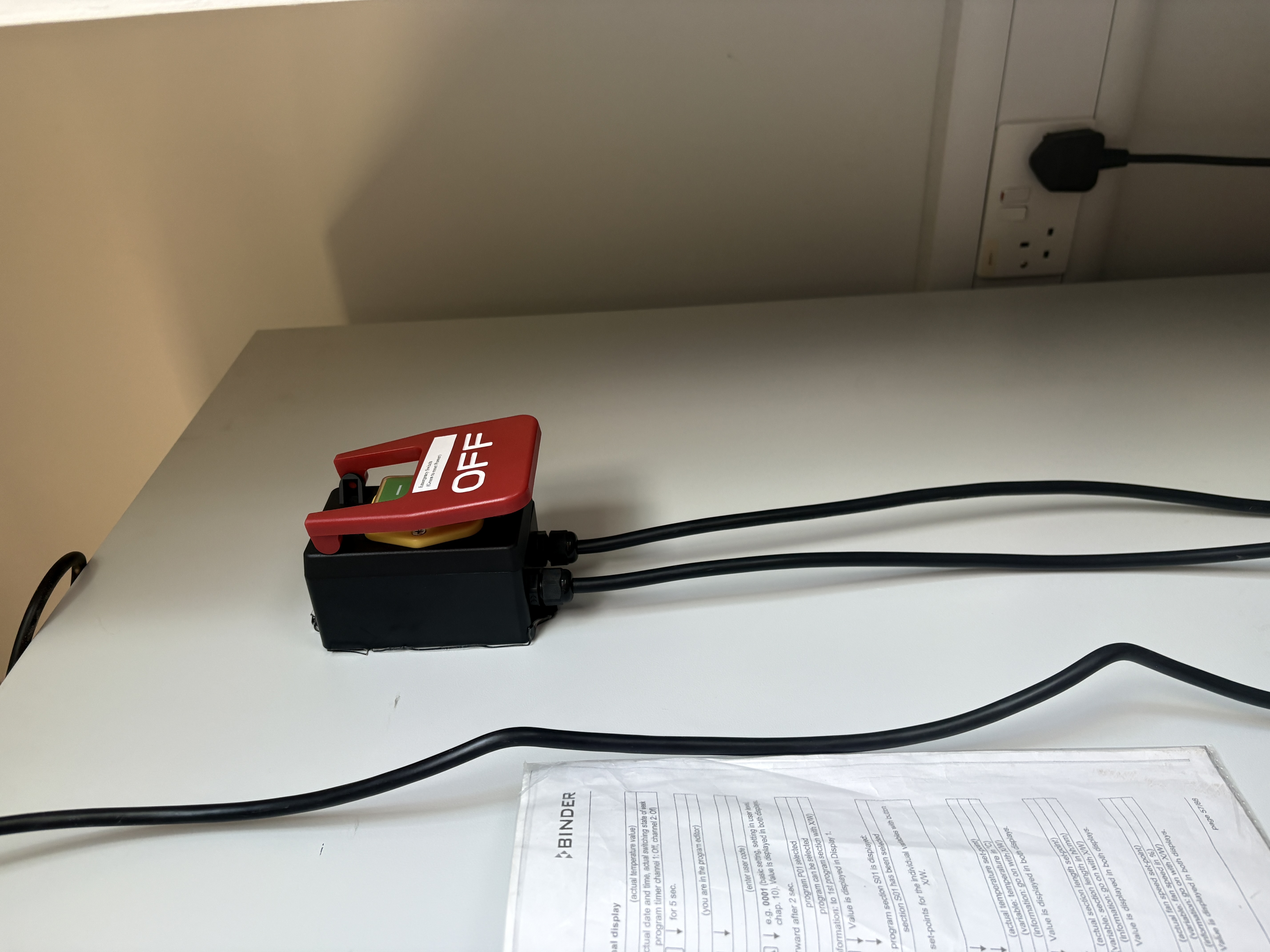
Hardware-related changes should be accompanied by documentation updates in
the appropriate documentation/ or hardware/ subdirectory.
Service and policy changes
Changes to service/policy behavior must include matching documentation updates:
/etc/systemd/system/automator-buttons.service/etc/polkit-1/rules.d/10-moonraker.rules
Update at minimum:
documentation/HARDWARE_BUTTONS_AND_SERVICES.mddocumentation/RunBook.md(operations baseline)
Imaging naming and tag workflow changes
If you modify QR setup (index_qr.html) or capture naming logic:
- keep QR setup separate from the optional experiment-tag field on the main imaging page unless intentionally changing that workflow
- preserve
_tag-<clean_tag>naming behavior for capture folders/files unless intentionally changed - document the change in operator/operations docs
Code style and quality
- Follow existing coding patterns
- Avoid introducing global side effects at import time
- Prefer explicit behavior over implicit assumptions
- Do not introduce breaking changes without discussion
All code must pass existing CI checks before review.
Dependency changes
Development-only dependencies may be closed without merging if they do not affect deployed systems or runtime behavior.
Security-related dependency updates are reviewed on a case-by-case basis.
Pull request guidelines
Each pull request should include:
- A clear description of what changed
- Why the change is necessary
- Whether it affects:
- system behavior
- safety model
- documentation scope
If a change affects operators or physical behavior, say so explicitly.
Out of scope contributions
The following are not accepted without prior discussion:
- Claims of certification or safety compliance
- Medical, clinical, or diagnostic use cases
- Removal or weakening of safety disclaimers
- Bypassing systemd or lifecycle controls
- Introducing undocumented hardware dependencies
Responsibility and use
By contributing, you acknowledge that:
- Automator is research tooling, not a certified instrument
- Contributors are responsible for the correctness of their changes
- Users remain responsible for validating the system in their environment
Questions or proposals
For larger changes, open an issue first describing:
- the proposed change
- affected components
- potential risks
- expected benefits
This helps ensure alignment before work begins.
Thank you for helping improve Automator in a safe, transparent, and responsible way.